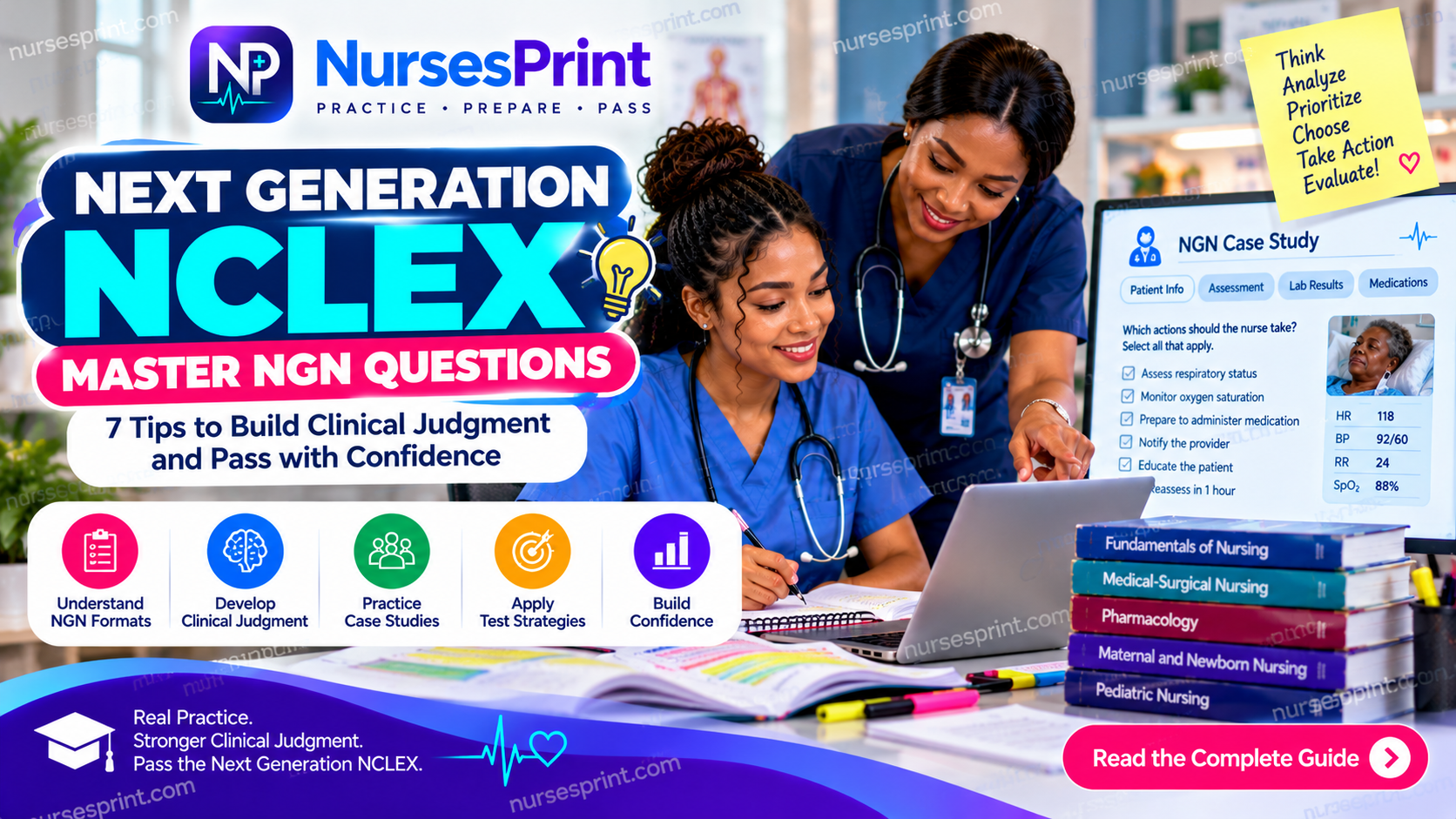
Preparing for the Next Generation NCLEX can feel challenging, especially when you encounter unfamiliar question formats and complex patient scenarios. Unlike traditional knowledge-based questions, Next Generation NCLEX questions place greater emphasis on clinical judgment and the ability to make safe nursing decisions.
Understanding how these questions work can help you prepare more effectively and approach your nursing licensing examination with confidence.
This guide explores seven practical strategies for mastering NGN questions and improving your clinical reasoning skills.
1. Understand What the Next Generation NCLEX Evaluates
The Next Generation NCLEX assesses how nursing candidates recognize patient problems, interpret clinical information and select appropriate nursing actions.
Its clinical judgment framework includes six cognitive operations:
Recognize cues
Analyze cues
Prioritize hypotheses
Generate solutions
Take action
Evaluate outcomes
These processes reflect important decisions nurses make during patient care.
Review the official Next Generation NCLEX information from NCSBN to understand the examination's clinical judgment focus.
2. Familiarize Yourself With NGN Question Formats
Next Generation NCLEX questions may use several interactive formats.
Examples include extended multiple-response questions, matrix/grid questions, cloze questions and bow-tie items.
Some questions require you to identify multiple relevant findings while others ask you to connect patient conditions with appropriate interventions.
Understanding these formats can reduce confusion during examination preparation.
Practice interpreting instructions carefully because different questions may have different response requirements.
3. Practice NGN Case Studies Regularly
NGN case studies present realistic patient situations that develop through several related questions.
You may need to review nursing notes, vital signs, laboratory findings and medication records.
Rather than focusing on isolated facts, consider how the information relates to the patient's overall condition.
Practice questions can help strengthen your ability to interpret clinical scenarios.
Explore nursing examination preparation resources at NursesPrint to support your study routine.
4. Learn to Recognize Important Clinical Cues
Recognizing relevant information is essential when answering NGN questions.
Clinical cues may include abnormal assessment findings, unexpected symptoms or changes in laboratory results.
For example, a patient experiencing sudden shortness of breath and declining oxygen saturation may require urgent assessment.
Distinguish important findings from information that does not directly influence the immediate clinical decision.
This skill helps you focus on patient safety.
5. Strengthen Your Clinical Judgment and Prioritization Skills
Clinical judgment involves interpreting patient information before selecting appropriate actions.
Consider which patient problems are most urgent and which interventions address immediate safety concerns.
The Agency for Healthcare Research and Quality provides valuable resources on patient safety and healthcare quality.
Reviewing patient safety principles can reinforce your understanding of appropriate nursing decisions.
Remember that prioritization depends on the complete clinical situation rather than a single memorized rule.
6. Review Answer Rationales After Every Practice Session
Completing NGN practice questions is only one part of effective preparation.
Understanding the reasoning behind correct and incorrect responses is equally important.
After each practice session, identify which clinical cues you overlooked.
Ask yourself whether you misunderstood the patient's condition or selected an inappropriate intervention.
Keep a record of challenging topics and revisit them during revision.
This approach helps transform mistakes into learning opportunities.
7. Build a Consistent NGN Study Routine
A structured study schedule helps you review nursing concepts while developing clinical reasoning skills.
Dedicate time to case studies, question-format practice and revision.
Alternate between subjects such as pharmacology, medical-surgical nursing and maternal health.
Monitor your progress to identify areas requiring additional attention.
Avoid relying entirely on memorization.
Instead, focus on understanding why particular nursing interventions are appropriate.
Final Thoughts: Prepare Confidently for the Next Generation NCLEX
Mastering Next Generation NCLEX questions requires consistent practice, strong clinical knowledge and effective decision-making skills.
By understanding NGN question formats, recognizing important clinical cues and reviewing detailed explanations, you can improve your examination readiness.
Remember that successful preparation involves learning how to think through patient situations rather than simply memorizing answers.
Ready to strengthen your NGN preparation?
Visit NursesPrint to explore nursing study resources and continue developing your clinical judgment skills.
Practice With Purpose. Think Like a Nurse. Prepare With NursesPrint.